It is human nature to wonder at the purpose of life's events. Especially the bad ones. Few stop to consider why good things happen -- they simply rejoice and enjoy them. But when bad things happen, we lament, "why?"
Why must there be a "why"? Perhaps in a world full of cause and effect, it is only logical to assume the pattern holds true for ourselves. Or perhaps we simply can't bear the idea of pure randomness, that things happen for no reason.
That ill befalls us for no cause violates our concept of justics, of fairness. But as your mother might say, "who said life was fair?" But in a world so full of beauty and symmetry, perhaps fairness just seems right. Or maybe "reason" is a better word; in nature, nothing happens without reason. A lion kills a zebra calf because the lion is hungry and the calf is weak. The "reason" for this seemingly brutal act is not only to feed the lion but to keep the zebra species strong. It is nature's balance, her symmetry.
So it is only logical to apply such balance to ourselves. If something bad happens, it must be for some reason. But what? So we make up tales to explain the inexplicable: God is punishing us for some sin; God has some mysterious and divine purpose; that it's karmic payback for some past wrong committed in this life or one past.
The aspiritual among us will call this hogwash and say there's no reason. Shit happens, period. No reason, no purpose -- it is what it is, to no particular end. And maybe they're right -- who's to know? But if they are, then our lives would be the sole exception to nature's machinery. How likely is that? How could it be that among the vast and complex relationships in our world, that we are the only beings free from it?
Let us examine things from this framework then -- not one of Divine Purpose but of nature. If the purpose of killing the zebra clf is to ensure the strength of the species, then might not our suffering be similar? It would be a weak species indeed that curled up into a ball of self-pity and depressed inactoin every time tragedy struck. That which doesn't kill us makes us stronger, after all.
This is not to say there is an Intent behind things that happen, for that would just replace God or karma with a personnified Mother Nature. There is no intent behind the lioin and zebra, but merely a system of checks and balances that naturally arose. As part of the natural world, we would be subject to the same balances. While we have largely removed ourselves from the basic checks of the environment (though not for much longer), might not we, with our large brains and self awareness, be subject to a psychological version of the same?
Personally, I have gone beyond wondering why. You may know that Shit Happened in my life recently, and rather than lament on the reason I find I am just numbly accepting it. Allowing myself a little leeway for withdrawing into a little ball, but also carrying on with life. Yes, friends are full of comforting assertions that there must be a reason for it, that something better will come of it. And typically I would agree, but not this time. Did god send me lemons because he wants me to make lemonade? Hardly. It's not the lesson I "should" learn (intent) but what I "could" learn (opportunity).
Showing posts with label fate. Show all posts
Showing posts with label fate. Show all posts
Wednesday, July 11, 2012


Thursday, January 26, 2012
Now I am Become Death: Apocryphal Quote?
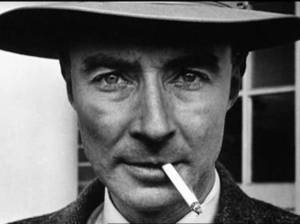
As you might guess from my choice of blog banner, I am into J. Robert Oppenheimer. I am also into Hinduism, so it was only a matter of time that these two interests of mine intersected.
In fact, it was because of Oppie that I first read the Bhagavad Gita many years ago. Being that it was the first such text I'd read and that I was rather young (and that I read it on Spring Break, which should indicate the state of sobriety I might have been in), I didn't get much out of it. I remember coming away from the experience thinking, "huh. That's it?"
Twenty years later I have, as one should, deepened my spiritual wisdom and reread the Gita a few more times, all in the past two years. In three different translations, I found a glaring absence of Oppie's famous Trinity-blast quote: "Now I am become Death, destroyer of worlds." I've also heard that this was apocryphal, that he never said it and that it was added later to the story. So, hi-ho, hi-ho, to the internet I go.....
The closest translation I found was "Now I am become Time, destoyer of worlds." Ok, I get that. Time equals death after all, right? Death sounds better, more dramatic. Another translation stretches it out a bit: "I am time that has aged, who makes the world perish. I have come forth to destroy worlds." Wordier, but the same idea. Wikipedia goes one step further in claiming that Oppie translated the quote himself, from the original Sanskrit. Without being a Sanskrit expert, I can't comment on the accuracy of his translation -- but since he's a supergenius and I'm not, I'll give him the benefit of the doubt.
Semantics aside, did he really say this or not? One can quite easily find several references -- including video of Oppie himself -- saying that he thought of this line after the Trinity blast, not that he said it. In fact, his brother Frank stated that Oppie simply said, "It worked." So, if others have turned this into an actual quote in their versions, it's fantasy (but good story telling).
But what's really interesting about all this is not what Oppie did or did not say but what the Gita might have meant to him in relation to his involvement in the Manhattan Project. It's easy to look back and say, "How could they have lived with themselves for creating such a horrible device? How could they have knowingly unleashed that on the world?" And in fact this very point has been portrayed numerous times in documentary ("The Day after Trinity" is a must-see for any nuke-geek) and films ("Fat Man and Little Boy" for example): there is a large body of evidence to show that many of the scientists felt regret and responsibility to work for responsible nuclear policies after the war. It is also well-documented that Oppie felt conflicted (tormented?) for the rest of his life.
But in reading the Gita again, in its full context within the larger Mahabharata, there is a very different aspect to Oppie's story. The whole point of the Gita is that warrior Arjuna feels conflicted at his "duty" to kill his cousins in battle, and he asks Krishna's counsel. Krishna's point can be summed up as: don't worry about the outcome of your actions; just do them. "Be an instrument, nothing more" (11 v. 33). That sounds harsh, but what Krishna is saying is that to be fully free and enlightened, you can't be attached to this world -- even your own actions. Do them because you must -- because it is your dharma (fate) -- but don't do them with thought toward the fruits (results) of those actions. Everything that will happen, has happened, and it has happened because Krishna willed it so. So be his instrument of Fate (my own humble paraphrasing).
This presents an interesting view of Oppie. The Gita was a huge influence on him, by his own words. So how did it play into his role as the Father of the Atomic Bomb?
It is possible that, if he truly took the Gita to heart, he was able to hold a certain emotional distance from the Manhattan Project. That he was able to view it rationally, because it was right (to stop Hitler) or his dharma (it was his duty as a top physicist) or simply that he was riding the tide of historical events. Krishna would tell him to create the bomb, knowing it would kill many people, because it was the thing to do. Because Oppie was merely an instrument of the Cosmos.
Obviously, Oppie could only take Krishna's counsel so far -- as evidenced by the deep regret he felt for the rest of his life. But it does shed light on how he could have played his role at the time. All of this is not to say that he blindly said "oh well, it's all preordained and I'm just the hand of god" -- which is a narrow-minded and shallow view. It simply shows how one can do one's duty in life even while conflicted about it.
A simple blog entry cannot possibly do justice to the full teachings of the Gita or the complex person that was Oppie. But I hope I've at least provided some food for thought.
In fact, it was because of Oppie that I first read the Bhagavad Gita many years ago. Being that it was the first such text I'd read and that I was rather young (and that I read it on Spring Break, which should indicate the state of sobriety I might have been in), I didn't get much out of it. I remember coming away from the experience thinking, "huh. That's it?"
Twenty years later I have, as one should, deepened my spiritual wisdom and reread the Gita a few more times, all in the past two years. In three different translations, I found a glaring absence of Oppie's famous Trinity-blast quote: "Now I am become Death, destroyer of worlds." I've also heard that this was apocryphal, that he never said it and that it was added later to the story. So, hi-ho, hi-ho, to the internet I go.....
The closest translation I found was "Now I am become Time, destoyer of worlds." Ok, I get that. Time equals death after all, right? Death sounds better, more dramatic. Another translation stretches it out a bit: "I am time that has aged, who makes the world perish. I have come forth to destroy worlds." Wordier, but the same idea. Wikipedia goes one step further in claiming that Oppie translated the quote himself, from the original Sanskrit. Without being a Sanskrit expert, I can't comment on the accuracy of his translation -- but since he's a supergenius and I'm not, I'll give him the benefit of the doubt.
Semantics aside, did he really say this or not? One can quite easily find several references -- including video of Oppie himself -- saying that he thought of this line after the Trinity blast, not that he said it. In fact, his brother Frank stated that Oppie simply said, "It worked." So, if others have turned this into an actual quote in their versions, it's fantasy (but good story telling).
But what's really interesting about all this is not what Oppie did or did not say but what the Gita might have meant to him in relation to his involvement in the Manhattan Project. It's easy to look back and say, "How could they have lived with themselves for creating such a horrible device? How could they have knowingly unleashed that on the world?" And in fact this very point has been portrayed numerous times in documentary ("The Day after Trinity" is a must-see for any nuke-geek) and films ("Fat Man and Little Boy" for example): there is a large body of evidence to show that many of the scientists felt regret and responsibility to work for responsible nuclear policies after the war. It is also well-documented that Oppie felt conflicted (tormented?) for the rest of his life.
But in reading the Gita again, in its full context within the larger Mahabharata, there is a very different aspect to Oppie's story. The whole point of the Gita is that warrior Arjuna feels conflicted at his "duty" to kill his cousins in battle, and he asks Krishna's counsel. Krishna's point can be summed up as: don't worry about the outcome of your actions; just do them. "Be an instrument, nothing more" (11 v. 33). That sounds harsh, but what Krishna is saying is that to be fully free and enlightened, you can't be attached to this world -- even your own actions. Do them because you must -- because it is your dharma (fate) -- but don't do them with thought toward the fruits (results) of those actions. Everything that will happen, has happened, and it has happened because Krishna willed it so. So be his instrument of Fate (my own humble paraphrasing).
This presents an interesting view of Oppie. The Gita was a huge influence on him, by his own words. So how did it play into his role as the Father of the Atomic Bomb?
It is possible that, if he truly took the Gita to heart, he was able to hold a certain emotional distance from the Manhattan Project. That he was able to view it rationally, because it was right (to stop Hitler) or his dharma (it was his duty as a top physicist) or simply that he was riding the tide of historical events. Krishna would tell him to create the bomb, knowing it would kill many people, because it was the thing to do. Because Oppie was merely an instrument of the Cosmos.
Obviously, Oppie could only take Krishna's counsel so far -- as evidenced by the deep regret he felt for the rest of his life. But it does shed light on how he could have played his role at the time. All of this is not to say that he blindly said "oh well, it's all preordained and I'm just the hand of god" -- which is a narrow-minded and shallow view. It simply shows how one can do one's duty in life even while conflicted about it.
A simple blog entry cannot possibly do justice to the full teachings of the Gita or the complex person that was Oppie. But I hope I've at least provided some food for thought.
Subscribe to:
Posts (Atom)